

Highlights
“The known-or-knowable standard requires analytical integrity. True point-in-time data makes that integrity operational.“
In business valuation, few concepts are as foundational—or as frequently misunderstood—as the “known or knowable” standard. At its core, the principle seems straightforward: a valuation should consider only those facts and circumstances that were known or reasonably knowable as of the valuation date. But in practice, this standard is where technical rigor, professional judgment, and data integrity converge.
For valuation professionals advising on M&A transactions, shareholder disputes, tax matters, or financial reporting, the known-or-knowable framework is not simply a legal construct. It is the guardrail that preserves objectivity and analytical credibility.
In an era defined by information abundance and continuously updated financial databases, the question is no longer whether information exists. It is whether it was accessible, relevant, and reasonably foreseeable at a specific moment in time—and whether the data being used today faithfully reflects that moment.
Valuing in a Moment, Not in Hindsight
The known-or-knowable doctrine requires that valuation analyses reflect only the information available—or reasonably discoverable—on the valuation date. Subsequent events may confirm expectations or prove them wrong, but they cannot retroactively influence fair value conclusions.
This is especially critical in contexts such as:
-
Shareholder disputes
-
Litigation and damages analysis
-
Estate and gift tax valuations
-
Fairness opinions
-
Purchase price allocations
-
Post-closing purchase price disputes
Hindsight bias is powerful. Once outcomes are known, they can feel inevitable. Revenue declines appear predictable. Market contractions seem obvious. Strategic missteps look foreseeable.
Yet valuation professionals are tasked with reconstructing expectations—not rewriting history.
The discipline lies in separating ex post outcomes from ex ante expectations.
Foreseeability vs. Speculation
Defining what was “reasonably knowable” is not a binary exercise.
Information generally falls into three categories:
-
Public and widely disseminated information – macroeconomic indicators, industry trends, regulatory developments, and observable market transactions.
-
Company-specific internal information – management forecasts, backlog, pipeline visibility, operational challenges, and capital constraints.
-
Emerging or speculative developments – early signals, rumors, or unverified disruptions.
The valuation professional’s task is to determine whether a hypothetical market participant would reasonably incorporate that information into pricing decisions as of the valuation date.
If a material contract was signed prior to the valuation date, it is knowable. If negotiations were ongoing but uncertain, inclusion requires judgment. If a contract was signed after the valuation date, it is generally excluded unless it reflects measurable conditions already present.
Subtle distinctions. Material consequences.
The Often Overlooked Risk: Revised and Restated Data
One of the most underappreciated threats to the known-or-knowable standard is the use of financial data that has been revised, restated, or retroactively updated after the valuation date.
Modern financial databases routinely overwrite historical figures with:
-
Post-period accounting restatements
-
Reclassified segment reporting
-
Revised EBITDA definitions
-
Updated share counts
-
Retroactively adjusted macroeconomic indicators
-
Restated comparable company financials
From an accounting perspective, these revisions may improve technical accuracy. From a valuation defensibility perspective, they can introduce hindsight.
If a company restates revenue six months after the valuation date, that information was not known to market participants at the time. If a data provider refreshes historical EBITDA based on amended filings, the analyst may unknowingly rely on numbers that did not exist on the valuation date.
The analysis appears historically grounded—but the data has been rewritten.
In litigation, tax controversy, or fairness opinion contexts, that distinction can be dispositive.
Why Point-in-Time Data Matters
Point-in-time data preserves the informational environment exactly as it existed on the valuation date—no revisions, no retroactive enhancements, no silent updates.
This includes:
-
Financial statements as originally reported
-
Market prices and trading multiples observable on the date
-
Consensus estimates available at that time
-
Risk-free rates, equity risk premiums, and credit spreads then in effect
-
Comparable transaction data as publicly disclosed
Without point-in-time integrity, even the most sophisticated discounted cash flow model or market approach analysis risks distortion.
In high-stakes disputes, the question is often straightforward:
Were you using information that was actually available on the valuation date?
If the answer is unclear, credibility erodes quickly.
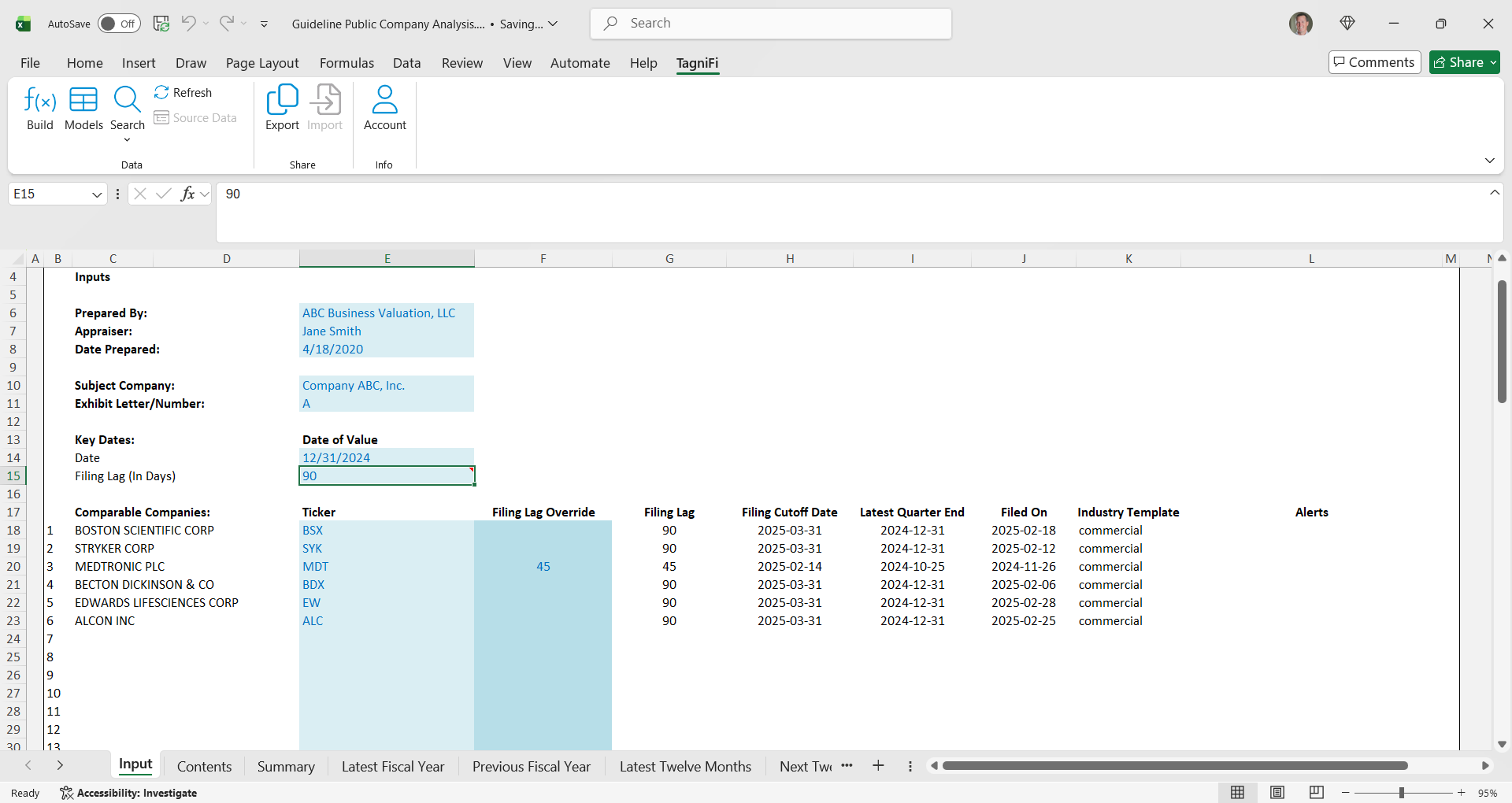
Practical Guidance: Public Comparable Financials and Filing Lags
One of the most common gray areas in applying the known-or-knowable standard involves financial statement timing for guideline public companies.
Consider a valuation date of December 31, 2025.
A public comparable also has a December 31 fiscal year-end. Its Form 10-K will not be filed until March 2026. As of the valuation date, audited financial statements are not yet publicly available.
Should fiscal year 2025 results be included in the comparable’s metrics?
Separate Economic Completion from Administrative Filing
As of December 31:
-
The fiscal year has ended.
-
Economic performance for the year is complete.
-
Management substantially knows year-end results internally.
-
Market participants understand that the fiscal year has closed.
The SEC filing lag is procedural. The underlying performance existed on the valuation date.
Excluding fiscal 2025 results solely because the 10-K had not yet been filed may unintentionally rely on stale 2024 financials—despite the fact that 2025 performance was economically complete.
Apply a Reasonable Filing Lag Convention
In practice, valuation professionals often apply a 60–90 day filing lag convention for annual financial statements when constructing point-in-time comparable datasets.
Under a 90-day convention:
-
A December 31, 2025 valuation would include fiscal 2025 results for December year-end comparables.
-
The inclusion reflects completed economic performance.
-
It aligns with how institutional investors view trailing performance.
The key is methodological consistency and transparent documentation.
Maintain Consistency Across Comparables
If a filing lag is applied, it must be applied consistently across the entire comparable set.
Selective updating distorts multiples and undermines defensibility. A rigorous framework should clearly document:
-
The valuation date
-
The lag convention applied
-
Confirmation of consistent treatment across companies
Avoid Crossing Into Hindsight
When the 10-K is filed in March 2026, it may include:
-
Audit adjustments
-
Reclassifications
-
Restatements
-
Subsequent event disclosures
Those elements were not publicly known on December 31, 2025.
The objective is to capture economic performance completed by the valuation date—not refinements or disclosures created afterward.Market Volatility and Timing Discipline
The known-or-knowable standard becomes even more demanding in volatile markets. Capital market conditions, volatility indices, and credit spreads must reflect the precise valuation date—not smoothed averages or subsequently revised datasets.
Freezing the informational environment is not optional; it is foundational.
This applies equally to financial statement timing. A clear and defensible lag policy protects against both understating known performance and inadvertently incorporating hindsight.
Documentation: The Professional Safeguard
A defensible valuation should clearly articulate:
-
What information was available as of the valuation date
-
Whether true point-in-time data was used
-
What filing lag conventions were applied
-
Why subsequent revisions or restatements were excluded
-
How contemporaneous market data informed key assumptions
In disputes and audit reviews, scrutiny often centers less on the conclusion and more on the process.
Defensibility is built on transparency.
Conclusion: Eliminating Hindsight Risk in a Revision-Prone Data World
The known-or-knowable standard demands more than technical competence. It demands data discipline.
Yet many widely used financial databases are not architected with this objective in mind. A common frustration among valuation professionals—particularly heavy users of platforms like Capital IQ—is that models update silently over time. Financial statements are restated. Segment data is revised. Consensus estimates refresh retroactively. Historical EBITDA changes months after a report is issued.
The valuation report remains frozen.
The data does not.
This creates professional risk. If a model built for a December 31, 2025 valuation looks different six months later—despite no methodological changes—questions arise. In litigation, fairness opinions, tax valuations, and audit reviews, those questions matter.
The issue is not data quality. It is the absence of point-in-time integrity.
TagniFi’s point-in-time database is designed specifically to solve this problem. Rather than overwriting history with subsequent restatements or revisions, TagniFi preserves financial and market data exactly as it existed on each date. When analyzing public comparables as of December 31, 2025, valuation professionals see:
-
The financials available at that time
-
The market data observable at that time
-
The consensus estimates published at that time
-
The capital structure information known at that time
No silent restatements.
No retroactive updates.
No creeping hindsight.
For professionals in business valuation, M&A, private equity, and corporate development, the stakes are too high for revision-driven models. The known-or-knowable doctrine is routinely tested—and increasingly scrutinized.
Markets evolve. Companies restate. Analysts revise forecasts.
But the valuation date does not change.
The known-or-knowable standard requires analytical integrity. True point-in-time data makes that integrity operational.
In a world where most databases rewrite history, TagniFi preserves it—so valuation professionals can defend it.